Hip Muscles Pictures and Exercises
Your hip muscles help to support and stabilize one of the body’s largest weight bearing joints. The hip joint is working hard whether we are still or moving.
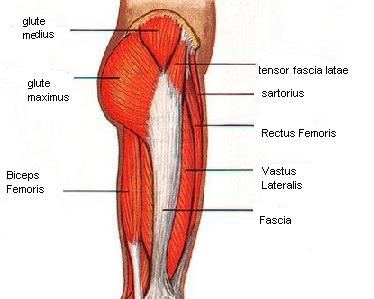
The hip is one of the most powerful joints in the body.
No wonder, it has to support our whole body weight!
It is a ball and socket joint helping to move the leg in four different ranges of motion.
There are four muscle groups and about 17 different muscles that move the hip in these four directions.
These muscle groups work together to support and stabilize the pelvic girdle that makes up the hip and sacrum region. Without this support we would not be able to walk or move freely from our legs.
There are tons of free articles below that will teach you the many ways to exercise these muscle groups:
- For Support and Stability of the hip joint.
- For Stretching the Hips.
- For Strength and Flexibility.
- And...Rehab for Hip and SI Joint pain and dysfunction.
FOUR HIP MUSCLE GROUPS:
1. The Abductors
This group of muscles works on the outside of the hip and thigh to move the leg out or away from the mid-line of the body.
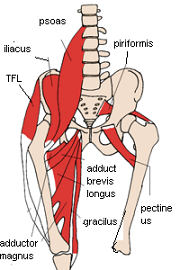
The hip abductors consist of the:
piriformis, external and internal obturators and the superior and
inferior gemelli.
2. The Adductors
This group is on the medial or inside of the hip and thigh and work to move the leg towards the mid-line of the body.
This group consists of the adductors brevis, longus, the psoas muscle group, ilacus, pectineus, and the gracilis.
3. Hip Extensors
The largest group that helps to extend the leg or take it back behind the body consists of the posterior muscles of the gluteus maximus, medius, minimus, hamstrings, and the tensor fasciae latae.
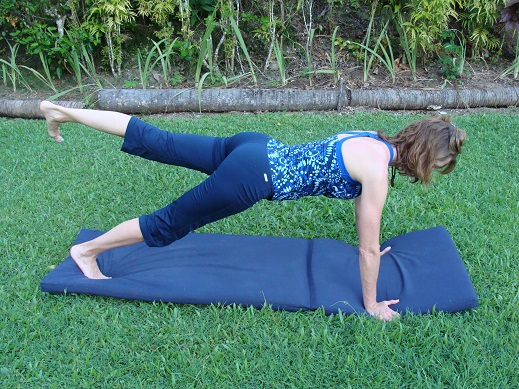
The image below shows hip extension from a plank support. This can also be accomplished standing or lying prone(on your belly). You will especially feel this in the glutes and hamstrings and get a bit of core abdominal work in this position.
Find more ways to work your glute muscles and save your back here.
4. Hip Flexors
The hip flexors bend or lift the leg for walking and include the iliopsoas and quadratus femoris.
The rectus femoris and Sartorius can cause movement at the hip joint also but mostly they work at the knee.
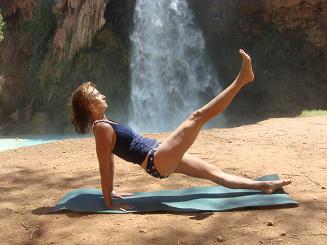
The hip flexion exercise below is an example of the Pilates leg pull back support, where you are using the deep hip flexors such as the psoas and pectineus to help pull the leg up from deep inside.
Along with these hip muscles are the hip ligaments and tendons. The hip ligaments attach the thighbone to the pelvis for added stability to the hip joint.
All of these muscles of the hips have tendons at the end where they meet the bone. These hip tendons connect muscles to bones.
Free Articles and Exercises for your Hip Muscles, Knees, and Legs
- Exercise for Reducing Hip Measurements
- How to Get Rid of 'Saddle Bags'
- Arthritis Hip Pain Relief Exercises!
- Hip Bursitis Exercise
- Hip Joint Exercise for Stability
- Hip Exercises for Women
- Exercise for Hips and Thighs
- Hip Replacement Exercise
- Stretching Exercises for the Hips
- Best Exercise for Hip Pain
- Hip Bridge Exercise
- Hip Stretches for Pelvic Imbalance
- Psoas Muscle Exercises for a Healthy Back
- Pelvic Floor Exercises for Spontaneous Activation
- SI Joint Exercises
- SI Joint Treatment
- Sacroiliac Joint Pain
- Exercises for Sacroiliac Joint Pain
- The Best Sciatic Nerve Exercises
- Stretches for Sciatica
- Sciatica Causes - How Pilates Helps!
- IT Band Treatment
- IT Band Syndrome
- Iliotibial Band Stretch for Relief!
- Joint Replacement Exercises
For the Knees:
- Knee Strengthening Exercise
- Exercise for Knee Joint Pain
- Save Your Knees, using a Foam Roller
- Pilates Leg Exercises for Strength and Flexibility
- Pilates for your Legs
Leave hip muscles and find out more about how Pilates exercises can benefit you.
--------------------------------------------------------------------------------------------------------
Are you searching for general Pilates articles or maybe want more information about hip exercises right for you?
You may use this Google search box to help find specific phrases or topics.
Be sure to check "Pilates-Back-Joint-Exercise.com" so you know you are getting the absolute best advice.
Recent Articles


-
Pilates after Total Knee Replacement
Apr 23, 20 06:20 PM
It's 2 yrs.post op since I had total knee replacement in both knees. In order for them to last it's recommended that you lift not more than 25 lbs. Pilates -
SI Joint Pain Improved with Pilates!
Aug 11, 17 12:29 AM
Dear Jennifer, I just wanted to reach out and thank you for dramatically improving and changing my life. About a year ago, I woke up in debilitating -
Hip pain after 4 months of Reformer Pilates
Jul 12, 17 06:44 PM
Hi, I had a total right hip replacement 8 months ago; I rehabbed really quickly, although I was also (and still am) dealing with L4 spondylolisthesis.
 | Get Instant Access to Loads of Color Pictures, Postures, and Information Designed to Increase Comfort and Happiness. Learn to Enjoy Life Again! Learn More! |


New! Comments
Have your say about what you just read! Leave me a comment in the box below.