SI Joint Exercise Using Pilates
SI Joint Exercise can be a real "pain in the butt" if we don't know what exercises to do.
The SI or Sacroiliac Joint is one of two joints in the pelvis that connects the sacrum or tailbone to the large pelvic bone, the ilium.
The SI Joint, in basic terms, supports the whole weight of the upper body.
So, if our posture is bad or we walk with a limp due to the pelvis being unbalanced we can have pain (particularly in the buttocks).
The
goal then, of doing SI Joint exercise is to perform range of motion and
hip stretches that help to balance, mobilize, and strengthen the joint ligaments.
See a good picture of the SI Joint and description of why you might have sacroiliac joint pain here.
Some of my favorite Pilates exercises that can be helpful in alleviating pain and stiffness in the SI Joint are:
Knee to Chest Stretch for SI Joint Pain:
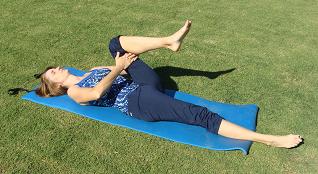
-Inhale to prepare and then exhale as you engage the abdominal muscles gently drawing one knee towards your chest.
-Hold for a 2 count, then release so the thigh moves back perpendicular to the ground.
-Do this 6-10 times with each leg.
A variation on this exercise to get into the SI Joint and muscles surrounding it: Cross one ankle over the opposite knee with the knee bent up in the air and repeat the sacroiliac joint stretch exercise.
Knee Sways or Hip and Back Rotation:
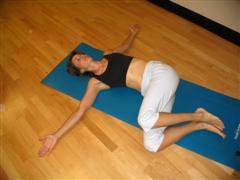
-Lying on your back with your knees bent, feet flat, and your arms out to the sides.
-Begin by keeping your feet flat on the floor, gently swaying the knees side to side. The mid back and ribs should remain fairly still on the mat.
As you improve you will be able to let the knees sway further to the floor feeling the lower back, hips, and ribs peel off the mat as shown in the picture.
-Do this for 4-8 times each side or more if you feel the si joint muscles releasing and no pain.
Also...check out some more Hip Stretches on this page.
Get Started with Action!
Listed below are a couple of SI Joint Exercises good for Stabilization of the pelvis:
Pelvic stabilization exercises should be performed to strengthen muscles that support the SI Joint that may be too loose.
This is important because the extra motion can cause wear and tear on the joint cartilage leading to degeneration and arthritis.
Knee Stirs or Pilates Leg Circles:
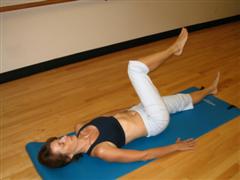
Position:
Lying on your back with your spine in neutral (tailbone and lower ribs in contact with the mat, natural curve in the lumbar spine), and hands on your hip bones.
Movement:
Exhale as you fold one knee up to a 90 degree angle from the hip joint so the shin is parallel to the floor. Feel the head of the thigh bone sink into the hip joint socket.
Keeping the pelvis stable and hips level circle the knee feeling the head of the femur rotate in the hip socket.
Circle clockwise and counterclockwise 4-8 times each direction for each leg.
Butterfly SI Joint Exercise:
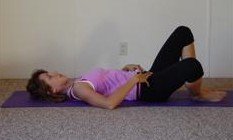
Position:
Lying on your back with your knees bent and squeezed together feet flat, place your hands on your hip bones and keep them still or level with the ceiling.
Movement:
Keeping your spine neutral with tailbone down and middle ribs pressed into the mat let your knees fall apart until you feel a gentle stretch in the groin, as you exhale draw them back together feeling the deeper pelvic floor muscles working.
Keep the buttocks relaxed. Do this for 6-10 repetitions.
Variation for this SI Joint exercise: Drop just one leg at a time toward the floor making sure the opposite buttock stays in contact with the mat and the hips stay level.
Prone Leg Circles as a good Hip Joint Exercise:
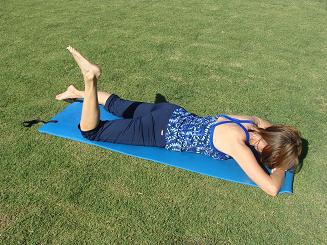
This hip joint exercise always felt great for me after my pregnancy. It really helped to loosen up the hip joint while strengthening the pelvic floor muscle.
Position:
Lying on your stomach with your head resting on forearms overhead, legs extended, and pubic bone pressed into the mat with abdominal muscles activated.
Movement:
Bend one leg at a 90 degree angle and circle the lower part of the leg 6 times each direction.
Be sure to keep the hip bones and pubic bone in contact with the mat and abdominals drawn up and in keeping the pelvis still as you circle just the lower part of the leg.
Pilates Bridge:
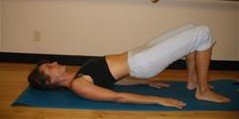
-Work towards doing the Pilates Bridge after you can do the other SI Joint exercises with ease.
-This is a great way to stretch the back and help the stabilizing muscles of the pelvis and hips.
-Practice this by coming up in a neutral or straight spine position and then rolling down.
-Exhale as you press the hips up flattening the abdomen.
-Inhale at the top and then exhale to roll back down. Repeat this SI Joint Exercise for 8-10 repetitions.
-Use a ball between your knees for added support of the pelvis and to work evenly through both sides.
Find more exercises for healthy back and joints in this Pilates DVD.
Recent Articles


-
Pilates after Total Knee Replacement
Apr 23, 20 06:20 PM
It's 2 yrs.post op since I had total knee replacement in both knees. In order for them to last it's recommended that you lift not more than 25 lbs. Pilates -
SI Joint Pain Improved with Pilates!
Aug 11, 17 12:29 AM
Dear Jennifer, I just wanted to reach out and thank you for dramatically improving and changing my life. About a year ago, I woke up in debilitating -
Hip pain after 4 months of Reformer Pilates
Jul 12, 17 06:44 PM
Hi, I had a total right hip replacement 8 months ago; I rehabbed really quickly, although I was also (and still am) dealing with L4 spondylolisthesis.
 | Get Instant Access to Loads of Color Pictures, Postures, and Information Designed to Increase Comfort and Happiness. Learn to Enjoy Life Again! Learn More! |


New! Comments
Have your say about what you just read! Leave me a comment in the box below.