Pilates Bridge for Pelvic Stability!
The Pilates Bridge or pelvic lift is one of the best exercises you can do for pelvic back pain because it helps to strengthen the muscles that support and stabilize the pelvis and hip muscles.
Find out how to do the bridge or pelvic lift correctly and then how to add variations and more challenge to it here in my video.
I use the Pilates bridge in my classes as a back warm-up exercise to help students stretch and open the vertebra in the spine as they articulate or roll the spine up and down the mat.
This articulating motion helps the cerebral spinal fluids to move up and down the spine from the sacrum to the cortex of the skull. In effect you realize more energy, clearer thinking, and increased circulation throughout the body.
Other benefits of the Pelvic lift includes more strength in the hips, hamstrings, and gluteal or buttock muscles, while simultaneously actively stretching the quadriceps and hip flexors in front.
Position for the Pilates Bridge or Pelvic Lift:
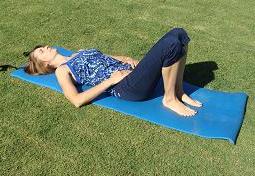
Start:
Lying on your back with your knees bent and heels just under the knees or a little farther away. Place your hands on your pelvis making sure it is neutral or parallel to the sky (meaning hip bones and pubic bone on same level and a little space in the lumbar spine).
Then bring your arms to your sides.
Feel the weight evenly through your feet.
2 VARIATIONS OF THE PILATES BRIDGE:
1. Articulating Bridge:
Inhale to prepare and as you exhale flatten your spine pressing evenly into your heels and curling the tailbone off the mat, then continue to peel the spine up one vertebra at a time until the weight is evenly between your shoulder blades.
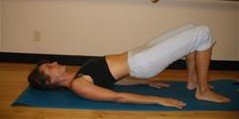
Take a breath in at the top and then exhale again as you roll or peel the spine from the top to the bottom releasing the tailbone last so you come back to neutral position.
If you have lower back pain this articulation of the spine may feel good for you to both stretch and strengthen the back simultaneously.
Caution! Do not peel the spine up so high that you have weight in your neck.
2. Neutral Pilates Bridging:
Neutral spine means that the ribcage and tailbone are in contact with the mat with just a natural curve or small space in the lumbar spine.
You'll want to do the Bridge this way if you have Osteoporosis in the spine or pelvic back pain.
Take a breath in to prepare and feel the muscles tighten and support the spine, then exhale to lift the pelvis straight up. The ribs and hips come up at the same time pressing evenly into your heels as you rise.
Inhale at the top then exhale to lower the pelvis and ribcage at the same time back to neutral position on the mat.
CHECK OUT ALL OF MY EXERCISE OF THE MONTH MOVES!
- Pilates The Hundred for a Great Warmup!
- Pilates Crisscross to work the Waistline!
- Pilates Rollup for a flatter tummy!
- Pilates Teaser
- Stability Ball Pushup for Core and Upper Body Strength.
- Leave Pilates Bridge and check out the Cat Stretch to Relieve Back Tension.
- Pilates Arrow as The Best Back Exercise.
- Stretch Lower Back Muscles with The Spine Stretch Forward.
- Pilates Side Kicks to Strengthen the Hips and Legs.
- Pilates Leg Circles for Well Toned Legs.
- A Great Pilates Stretch For The Lower Back.
Recent Articles


-
Pilates after Total Knee Replacement
Apr 23, 20 06:20 PM
It's 2 yrs.post op since I had total knee replacement in both knees. In order for them to last it's recommended that you lift not more than 25 lbs. Pilates -
SI Joint Pain Improved with Pilates!
Aug 11, 17 12:29 AM
Dear Jennifer, I just wanted to reach out and thank you for dramatically improving and changing my life. About a year ago, I woke up in debilitating -
Hip pain after 4 months of Reformer Pilates
Jul 12, 17 06:44 PM
Hi, I had a total right hip replacement 8 months ago; I rehabbed really quickly, although I was also (and still am) dealing with L4 spondylolisthesis.
 | Get Instant Access to Loads of Color Pictures, Postures, and Information Designed to Increase Comfort and Happiness. Learn to Enjoy Life Again! Learn More! |


New! Comments
Have your say about what you just read! Leave me a comment in the box below.