IT Band Syndrome
What is IT Band Syndrome?
Do you have a pain running along the outside of your leg, and you can't figure out what might be causing it?
Or...maybe you have been diagnosed with Iliotibial Band Syndrome, and now you are thinking; what’s next for me?
If you want to know how this syndrome develops, what type of problems it causes, and what treatment options are available, you’ve come to the right place!
Just what is the Iliotibial Band?
The iliotibial band (usually called IT band) is a thick band of fibrous tissue that runs from your hip and attaches below your knee, at the outside edge of the tibia (shinbone).
Your IT band works with several of your thigh muscles to provide stability to the outside of your knee joint. You can feel the IT band on the outside of your thigh when you tighten your leg muscles.
What causes IT Band Syndrome?
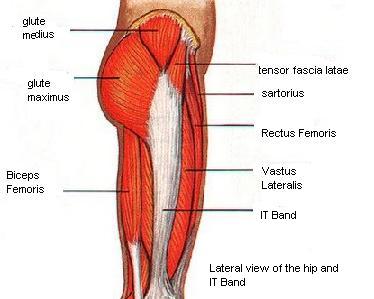
This syndrome running along the lateral side of the leg occurs when this band of fibrous tissue becomes irritated, inflamed, and tender. The irritation usually occurs over the outside of the knee joint, at the end of the femur (thigh) bone.
The IT band crosses bone and muscle at this point; between these structures is a bursa, which should facilitate a smooth gliding motion. However, the IT band does not glide easily when inflamed, and this lack of harmony causes that persistent pain that is all too familiar to those with IT Band Syndrome.
What are some symptoms?
Iliotibial Band symptoms range from a stinging sensation just above your knee joint (on the outside of your knee or along the entire length of the IT band) to swelling or thickening of the tissue at the point where the band moves over your femur.
You may not notice pain while you are active – if often becomes noticeable AFTER activity and continues to persist. The pain can also feel like a dull ache or a throbbing sensation.
Pain may radiate up the side of your thigh and down the side of your leg. People sometimes report a snapping or popping sensation on the outside of the knee. You may also have pain below your knee, where the IT band actually attaches to your shinbone.
IT Syndrome can also strike where the IT band connects to the hip, though this is usually not due to a sports injury.
Pain at the hip due to IT band problems most often affects the elderly.
How did I develop IT Band Syndrome?
Have you begun running more miles, or taken up a new sport, like tennis?
People who suddenly increase their level of activity often develop Iliotibial Band Syndrome.
An example would be a runner who suddenly increases her mileage, or a bicyclist who goes from biking on flat surfaces to pumping up hills.
Other causes aren’t so much about what you DO, as how your body is constructed and how you MOVE during everyday activities.
You may be prone to IT Band Syndrome if one of your legs is slightly longer than the other, your pelvis tilts to the side, your feet rotate too far inward (overpronation), or you are “bow legged.”
What’s more, if you have tight or inflexible gluteal(butt) or
thigh muscles, it may make the problem worse.
IT Syndrome also commonly occurs during pregnancy.
During this time: 1) the connective tissues loosen and
2) the woman gains weight. This is quite a double whammy, as each one of these processes adds more pressure to the IT band area!
Find out more about how Pilates exercises can help during Pregnancy here.
How do I treat IT Band Syndrome?
You definitely want to get some relief from that nagging pain, and there are a number of steps you can take.
Click here to find out more about hip stretches for conditions like this and more. Treatment begins with proper footwear, icing the area of pain, and a stretching routine. You will also need to rest in order for the inflammation to decrease. (I know, probably not what you wanted to hear!)
Start slowly or progressively when you take up a new sport or begin exercising, limit excessive exercise if you start to feel pain, and incorporate low-impact activities like Pilates.
Performing an IT Band Stretch is one of the most essential things you can do to help relieve the pain.
Recent Articles


-
Pilates after Total Knee Replacement
Apr 23, 20 06:20 PM
It's 2 yrs.post op since I had total knee replacement in both knees. In order for them to last it's recommended that you lift not more than 25 lbs. Pilates -
SI Joint Pain Improved with Pilates!
Aug 11, 17 12:29 AM
Dear Jennifer, I just wanted to reach out and thank you for dramatically improving and changing my life. About a year ago, I woke up in debilitating -
Hip pain after 4 months of Reformer Pilates
Jul 12, 17 06:44 PM
Hi, I had a total right hip replacement 8 months ago; I rehabbed really quickly, although I was also (and still am) dealing with L4 spondylolisthesis.
 | Get Instant Access to Loads of Color Pictures, Postures, and Information Designed to Increase Comfort and Happiness. Learn to Enjoy Life Again! Learn More! |


New! Comments
Have your say about what you just read! Leave me a comment in the box below.