Pilates and Back Pain: Common Injuries and how to avoid them
Why are there so many cases of Pilates and back pain all of a sudden?
There are many reasons for Pilates back pains and injuries.
The main reason is the recent popularity of Pilates and the increase in people practicing.
Another reason might be due to overcrowded classes and inexperienced teachers.
Because of the complexity and focus needed to execute the movements properly if they are not cued just right and without a proper warm-up you could wind up hurting yourself.
How can you avoid Pilates and Back Pain?
Let's look at some of the most common Pilates exercises that may contribute to back pains.
Imprinting the Spine:
When you imprint the spine into your mat this means you are pressing the spine or low back into the mat.
Why Not: This Pilates exercise can cause compression on the discs of the spine.
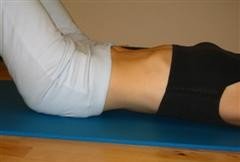
Better Option: Neutral Spine (using the natural curvature of the spine) is the only place where the muscles can work safely and effectively to support the spine in all movements.
Pilates Roll-Up:
Most people use momentum to do the roll-up.
Why Not: This exercise can cause Pilates lower back pains and injuries when done repetitively and with tight hip flexors and weak core muscles.
By jerking yourself up repetitively to try to accomplish this exercise can really damage your back over time.
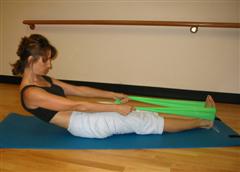
Better Option: Use a mini ball at your lower back to help support the spine as you roll into it only half way down.
Or, use a stretch band(as shown) looped around the feet to give yourself a little bit of tension to go down easily and support you coming up so you can avoid Pilates and back pain.
Make sure to keep your arms long and not pull yourself up with your arms, but use the rolling action of the spine and deep abdominals.
Swimming and Swan Dive:
Lying on your stomach with arms and legs extended.
Why Not: These exercises, when lifting the arms and legs to high can cause the back to hyperextend and cause excessive disc compression.
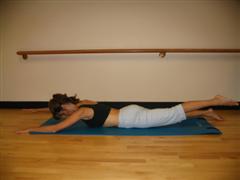
Better Option: Draw the abdominals up off the mat and extend one arm and opposite leg keeping the head down on the mat.
Rolling:
Rolling like a ball is supposed to be gentle and like a massaging action.
Why Not: If you have Osteoporosis this exercise can cause fractures of the spine if done too aggressively. Also, by throwing the head and not engaging the abdominal muscles it can cause compression of the lower back as well as whiplash in the neck.
Better Option: Practice just balancing on your tailbone sitting up or lying down to lose the back pain. Do this hugging your knees and rocking gently back and forth without rolling up all the way to a balance.
To avoid Pilates and Back Pain check out my newly revised Pilates Ebook with loads of detailed pictures and descriptions so you can learn how to safely and effectively do these and many more exercises.
Pilates Teaser:
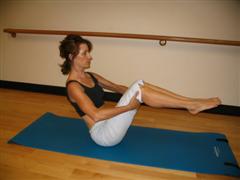
Advanced movement requiring you to come up into a V - sit movement.
Why Not: If you don't have strong and developed transverse abdominal muscles then you will not be able to properly execute this advanced movement. You will strain the lower back when rising up into the V-sit with your legs straight.
Better Option: Bend your legs grabbing under your thighs as you gently rock yourself forward and then up into a balanced position.
Leave Pilates and Back Pain and find ways Pilates exercises can help end your back pain.Recent Articles


-
Pilates after Total Knee Replacement
Apr 23, 20 06:20 PM
It's 2 yrs.post op since I had total knee replacement in both knees. In order for them to last it's recommended that you lift not more than 25 lbs. Pilates -
SI Joint Pain Improved with Pilates!
Aug 11, 17 12:29 AM
Dear Jennifer, I just wanted to reach out and thank you for dramatically improving and changing my life. About a year ago, I woke up in debilitating -
Hip pain after 4 months of Reformer Pilates
Jul 12, 17 06:44 PM
Hi, I had a total right hip replacement 8 months ago; I rehabbed really quickly, although I was also (and still am) dealing with L4 spondylolisthesis.
 | Get Instant Access to Loads of Color Pictures, Postures, and Information Designed to Increase Comfort and Happiness. Learn to Enjoy Life Again! Learn More! |


New! Comments
Have your say about what you just read! Leave me a comment in the box below.