Hip Bursitis Exercise:
Treat and Prevent it for Good
Living with and trying to do hip bursitis exercise can be a real pain in the butt!
Your hip bursitis may be caused by a number of things:
- Lack of stretching
- Bad posture
- Lack of muscle strength and mobility to support the joint.
The FIRST goal to prevent hip bursitis and exercise is to stretch:
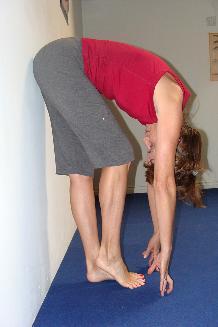
- Increase range of motion in the joint by gentle stretching before and after exercising, especially if you are a runner.
- The picture to the right shows a great runner's stretch to help loosen up the always tight IT Band.
- Lean into the wall with your feet lined up and hips level then alternate lifting each heel slowly.
- Make sure to keep your hips aligned.
- The iliotibial band which runs from the hip joint along the outside of the thigh needs to be stretched properly before and after exercise.
- This muscle can also be stretched lying down and gently pulling the leg across the midline of the body at about a 45 degree angle in line with the hip joint.
What is Hip Bursitis?
The bursa of the hip is a small fluid filled sac with lubricant that protects and aids in the gliding motion at the hip. If this sac is aggravated by some of the above conditions acting on the bursa it will become inflamed and may cause you pain.
If you do have hip bursitis and exercise, even with the pain, it may be time for you to change your thinking.
First, treat the hip bursitis and then worry about doing hip strengthening exercise or hip bursitis exercise later.
Treating Hip Bursitis:
- Control the inflammation by taking an anti-inflammatory medication.
- Rest
- Ice the affected area
- Once the inflammation and some of the pain has been alleviated from the area you can then begin to start exercising the hip muscles.
The SECOND goal for hip bursitis exercise is using the Pilates Principles:
Pilates exercises help to stretch and strengthen the muscles of the hip and upper leg while stabilizing the pelvis and core.
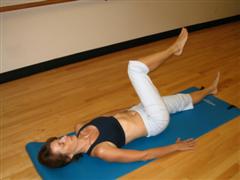
The Pilates Leg Circles have effectively helped some of my clients to stabilize the pelvis and strengthen the surrounding hip muscles.
Begin with the modified leg circles (bent knee or by using a stretch band) until you have no pain and then progress to the extended leg.
Repeat the circles each direction for 6-8 repetitions.
Pilates Side Kicks are also a great way to strengthen the hip muscles and support the pelvis.
These should also be done in a pain free range of motion to keep your hip bursitis at bay.
Pad your hips as much as you need to
when lying on your side to make the exercise more comfortable to do.
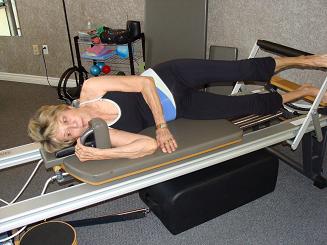
Also, side lying hip abduction work on the Reformer shown above is effective at strengthening these muscles that support the hip joint and a great way to do hip bursitis exercise to ward off the pain in the future.
The Pilates Reformer machine also gives you a stable surface to push off from and may be more comfortable to begin with than the open chain side kick exercises.
Leave hip bursitis exercise and find more great Pilates exercises to benefit you here.
Recent Articles


-
Pilates after Total Knee Replacement
Apr 23, 20 06:20 PM
It's 2 yrs.post op since I had total knee replacement in both knees. In order for them to last it's recommended that you lift not more than 25 lbs. Pilates -
SI Joint Pain Improved with Pilates!
Aug 11, 17 12:29 AM
Dear Jennifer, I just wanted to reach out and thank you for dramatically improving and changing my life. About a year ago, I woke up in debilitating -
Hip pain after 4 months of Reformer Pilates
Jul 12, 17 06:44 PM
Hi, I had a total right hip replacement 8 months ago; I rehabbed really quickly, although I was also (and still am) dealing with L4 spondylolisthesis.
 | Get Instant Access to Loads of Color Pictures, Postures, and Information Designed to Increase Comfort and Happiness. Learn to Enjoy Life Again! Learn More! |


New! Comments
Have your say about what you just read! Leave me a comment in the box below.