Learn Neutral Back Position with Pilates!
Why do we need to use neutral back position when doing exercises?
Neutral back position or “neutral spine” as we call it in Pilates is the safest and most effective way to exercise and strengthen our back without risking injury.
Neutral is a term used to describe the body position that is most naturally allowing for the curvatures of the spine.
When we strengthen the back in this position everything else in the body just works better.
We stand taller, sit without pain, have better posture, and decrease everyday stressors on our bodies.
Learning how to find neutral spine in various positions can assist you in daily activities while at work or when doing your own exercise routine.
Neutral Back Position - Lying:
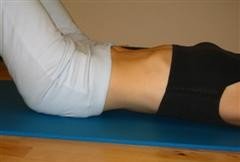
Lying on your back with knees bent and arms at your sides.
Starting with the tailbone, first make sure it is anchored or heavy on the mat. You should have a little space at the curve of your lumbar or lower back, this is part of the natural curvature of the back.
Move up to
the mid or thoracic (ribcage) region and pull the ribs down into the mat
without flattening the lower or lumbar spine. This is a common Pilates position you will use often in a mat class.
Your shoulders should be heavy into the mat with your arms long at your side. Pull your chin down so it is about a fist length from your chest feeling a stretch or lengthening in the back of the neck.
Take a few breaths in this position inhaling and feeling the ribs expand out to the sides and then exhaling bringing them back together.
As you are breathing scan your body and feel all the points discussed above touching the mat.
Check out the Pilates Ebook here to help you find the best Pilates position for a neutral spine and to strengthen those deep abdominal muscles.
Neutral Back Position - Sitting:
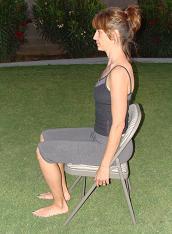
When sitting in a chair slide your bottom right up against the back of the chair and then stack everything else up over it.
Your feet(ankles) should be directly under your knees on the floor.
Your abdominal muscles should be pulled up and in under the ribcage, feeling the ribs floating up over your hip bones.
Your shoulders are directly over the hips with your chest lifted high and wide.
Your chin is pulled back so your ears are directly over your shoulders, feel the length in the back of your neck!
Doesn’t that stretch feel good?
Find out how Pilates can improve your posture here.Neutral Back Position - Standing:
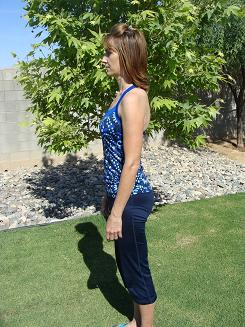
When standing up you may want to first test your body points against a wall.
Feel your buttocks against the wall; feet can be away from the wall a few inches.
Your lumbar spine or lower back is not flattened against the wall but allow for the natural curve there. Your ribcage should be pulled back with the abdominal muscles drawing up and in under the ribs.
Your chest is high and wide with your chin down, ears over shoulders, the back of your head may or may not touch the wall depending on the tightness in back of the neck.
Now, walk away from the wall and see if you can maintain this upright posture without slouching.
Imagine leading your walk with your chest, like someone is pulling you up and away by a leash connected at your breastbone.
Neutral Back Position - Side Lying:
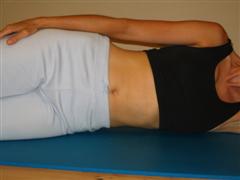
This position is important to get the most out of your Pilates Side Kicks.
When side lying, position yourself so your hips and shoulders are stacked on top of each other.
You should feel your waist pulled up and in, and off the mat slightly so your top foot feels like it is reaching out past the bottom one.
Keep this lengthened feeling and so the muscles between your hip bones are drawn in.
Keep this form as you go through the side kick series.
Recent Articles


-
Pilates after Total Knee Replacement
Apr 23, 20 06:20 PM
It's 2 yrs.post op since I had total knee replacement in both knees. In order for them to last it's recommended that you lift not more than 25 lbs. Pilates -
SI Joint Pain Improved with Pilates!
Aug 11, 17 12:29 AM
Dear Jennifer, I just wanted to reach out and thank you for dramatically improving and changing my life. About a year ago, I woke up in debilitating -
Hip pain after 4 months of Reformer Pilates
Jul 12, 17 06:44 PM
Hi, I had a total right hip replacement 8 months ago; I rehabbed really quickly, although I was also (and still am) dealing with L4 spondylolisthesis.
 | Get Instant Access to Loads of Color Pictures, Postures, and Information Designed to Increase Comfort and Happiness. Learn to Enjoy Life Again! Learn More! |


New! Comments
Have your say about what you just read! Leave me a comment in the box below.