Back Pain Relief Exercise Myths!
When you have back pain relief is probably what you are looking for.
When you have back pain, exercise is probably the last thing you want to do or are thinking about.
However, when exercise is done with the right amount of intensity and quality of movement it can be helpful when you have back pain.
Let's dispel some of the myths about back pain and exercise.
Some common myths about back pain are:
1. SIT UPS
Myth:
Doing crunches or sit ups will help to save our backs because we are strengthening our abdominal muscles.
Reality:
The old school sit-ups and crunches are not as effective as we once thought.
Remember in P.E class how we'd take turns holding each other's feet while the other person would jerk themselves up to a sit as fast as they could to break the school's sit-up record?
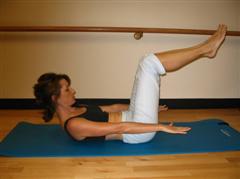
Old style sit-ups actually use the hip flexors and erector spinae(superficial muscles of the back) more than the deeper transverse abdominal muscles. This action pulls on the muscles of the back incurring strain.
Crunches generally work the superficial rectus abdominus muscles, which help us to bend forward, but do nothing to help support our spines internally.
Pilates exercises are most effective at working the deep transverse abdominal muscles that support our spine and provide us with back pain relief.
The flattening effect that you get in the abs from doing rollups, single leg stretch, the hundreds, just to name a few are the most effective way to have a strong midsection and, in effect a supported back.
2. WEIGHT BELTS
Myth:
Most of us believe that these belts around our midsection will help support our backs.
Well...O.K., they are keeping us upright and supported while making us aware of our back problems, but you can't wear a back support your whole life.
You aren't going to wear it to the beach, or in the shower, or when you roll over in bed...are you?
People that work in jobs where they are doing heavy lifting or driving heavy equipment are tricked into thinking they are protecting themselves against injury by wearing these belts.
Reality:These belts actually prevent the abdominal muscles that help to internally support our backs from developing and getting stronger through regular use.
The belts can actually cause atrophy in the muscles from disuse, just like if you were resting.
If you are using a weight belt currently the best thing you can do is to wean yourself off of it gradually. Start doing some core strengthening exercises every other day when you are not wearing it.
After a couple of weeks experiment with working without it for a day and see how you feel the next day. If you are still sore then try wearing it for half a day and continue doing the abdominal or core strengthening exercises.
Find more back pain relief exercises and information from my pages here.
3. RESTING
Myth:
Most people think that back pain relief comes from resting or lying flat on your back so that you give your back time to heal.
Reality:
In just 48 hours the muscles that support the back begin to atrophy or weaken, which makes it even more important to keep moving and doing some form of back pain exercise.
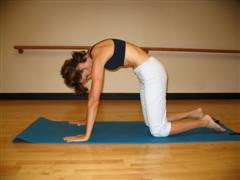
Your back pain relief exercise may be just some light stretching such as the cat stretch shown here to keep circulation of blood in the muscles and to prevent further atrophy of your muscles.
It's not a race, just slow gradual progression of walking and stretching to the point of pain, but not into your pain.
Never overdo! Just start with 5-10 minutes of walking or light stretching and if you feel o.k. the next day, then try it again, and then a little more.
4. HERNIATED DISC
Myth:
You can’t have a herniated disc without pain.
Reality:
Many people have herniated discs and don’t even know it. They have no pain and the x-rays may come out normal or abnormal.
The problem here is that back pain exercise that involves twisting and side bending can start out with no pain or negative consequences, but this may eventually turn into a more serious threat.
Doing Pilates for back pain today can help to prevent and ward off any future problems associated with a herniated disc leading to pain and possibly surgery.
A herniation is a disc bulging between the vertebra and then when you extend or flex or twist the spine depending on which direction the disc gets pinched there and can be painful.
Pilates helps to lengthen and strengthen the spine by stretching and opening the spaces between the vertebra taking pressure off the disc.
Check out this article to find out more about Common Pilates exercises and how to avoid injury.
Recent Articles


-
Pilates after Total Knee Replacement
Apr 23, 20 06:20 PM
It's 2 yrs.post op since I had total knee replacement in both knees. In order for them to last it's recommended that you lift not more than 25 lbs. Pilates -
SI Joint Pain Improved with Pilates!
Aug 11, 17 12:29 AM
Dear Jennifer, I just wanted to reach out and thank you for dramatically improving and changing my life. About a year ago, I woke up in debilitating -
Hip pain after 4 months of Reformer Pilates
Jul 12, 17 06:44 PM
Hi, I had a total right hip replacement 8 months ago; I rehabbed really quickly, although I was also (and still am) dealing with L4 spondylolisthesis.
 | Get Instant Access to Loads of Color Pictures, Postures, and Information Designed to Increase Comfort and Happiness. Learn to Enjoy Life Again! Learn More! |


New! Comments
Have your say about what you just read! Leave me a comment in the box below.